Diarrhea is a symptom, not a diagnosis. It may appear after eating something unsuitable, a sudden food change, stress, infection, medication or a medical condition that needs investigation. The first question is not only “what should I feed?”, but what else is happening in the body right now.
First: are there warning signs?
Seek veterinary care promptly when diarrhea appears together with:
- Marked lethargy, weakness, pain or an acute behavioral change.
- Repeated vomiting, difficulty drinking or concern about dehydration.
- A significant amount of blood, black stool or rapid deterioration.
- A very young puppy, a very old dog or a dog with an underlying condition.
- Suspected foreign-body or toxin ingestion.
- Diarrhea that persists, worsens or recurs frequently.
What should you check before changing the bowl?
- When it began: and what the dog ate, received or experienced during the preceding 24–72 hours.
- How the dog feels: appetite, drinking, energy, sleep, pain and vomiting.
- What the stool looks like: frequency, volume, color, mucus, blood and straining.
- Whether this is isolated or a pattern: a passing response that returns to balance is different from recurring diarrhea.
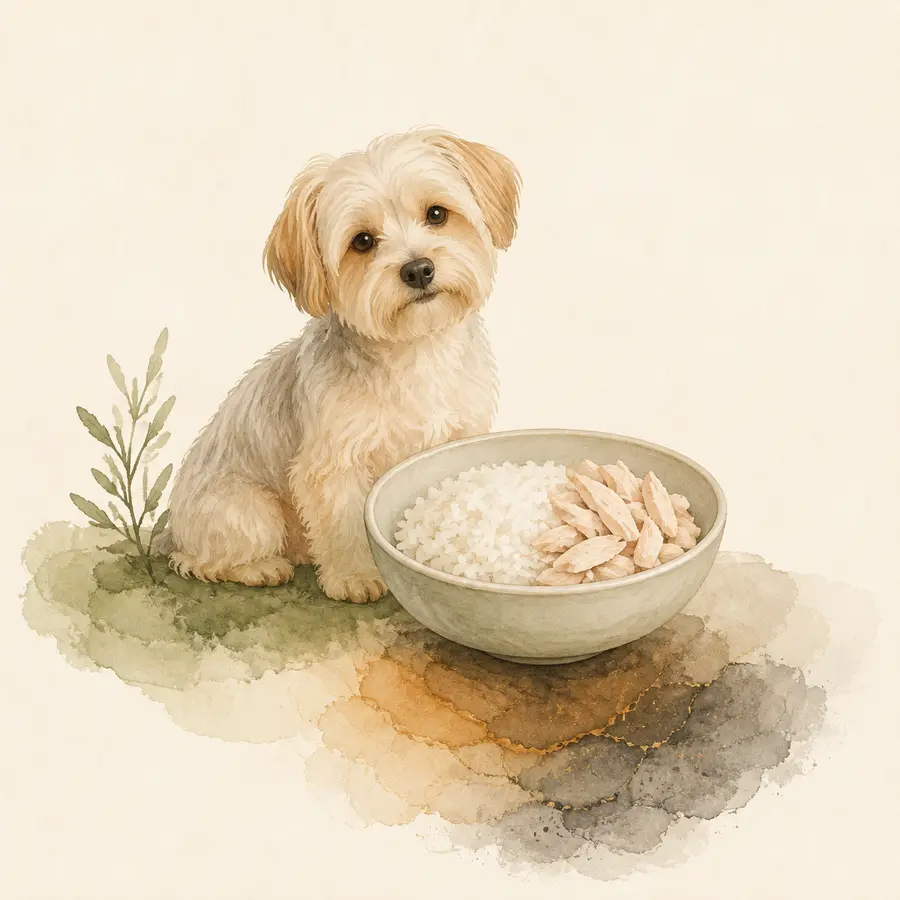
Why not automatically switch to chicken and rice?
Chicken and rice are not necessarily gentle for every dog. Chicken does not suit some dogs, rice worsens bowel movements in others, and changing several ingredients quickly can make it harder to understand what triggered the response.
Rather than changing many things at once, I prefer to simplify, document and tailor the next step to the individual dog. Read more about chicken and rice in a sensitive digestive system.
What if the diarrhea keeps returning?
Recurring diarrhea calls for a wider lens: dietary history, medication and antibiotic use, responses to specific ingredients, microbiome status, stress, tests and the relationship between bowel movements and other signs in the body.
The aim is not to stop every soft stool at any cost, but to understand why the digestive system struggles to stabilize. Read about the antibiotic cycle in chronic diarrhea and the “sudden” event that was not really sudden.
Sources and further reading
For general information on gastrointestinal disorders and warning signs: Merck Veterinary Manual. For professional gastrointestinal guidance: WSAVA Gastrointestinal Guidelines.